
Quartz vs Quartzite Countertops for Your Kitchen
Published:
Quartz vs quartzite countertops compared for Florida kitchens: durability, maintenance, heat, cost, and design guidance for a polished renovation project.
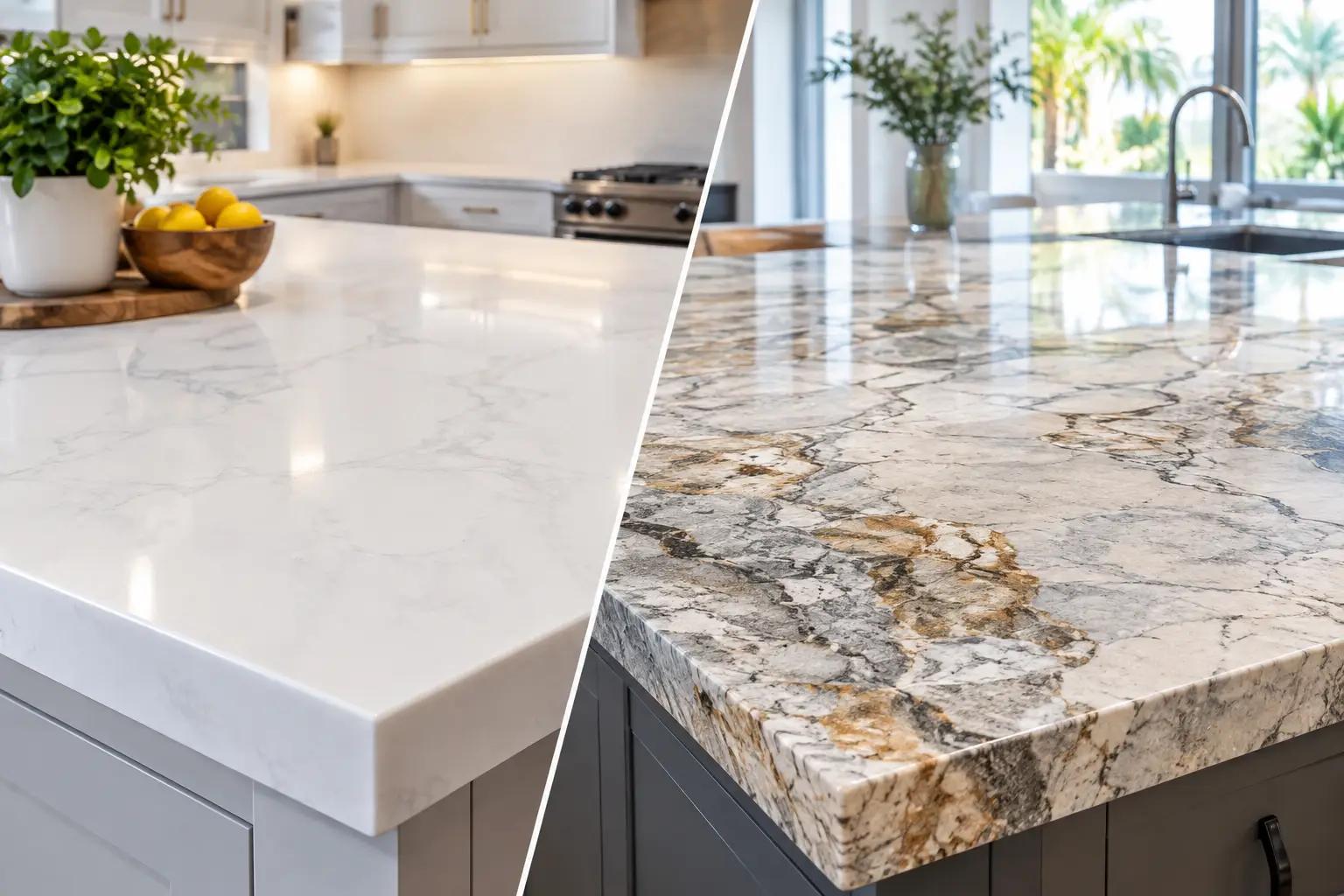
A countertop can make a kitchen feel quietly finished or make every other design decision seem slightly off. When homeowners compare quartz vs quartzite countertops, the choice often comes down to more than appearance. It affects how the kitchen performs during busy mornings, how much care the surface needs, and how confidently it will hold up over years of entertaining, cooking, and daily use.
Both materials can create an elevated kitchen. They are not interchangeable, however. Quartz offers controlled color and low-maintenance practicality, while quartzite brings the movement and individuality of natural stone. The right decision depends on how you live, the light in your home, and the level of variation you want to see in the finished space.
Quartz vs Quartzite Countertops: The Essential Difference
Quartz countertops are engineered surfaces. They are made from crushed natural quartz combined with resins, pigments, and binders, then manufactured into slabs. This process allows for a broad range of consistent colors and patterns, including designs that resemble marble, concrete, limestone, or softly veined natural stone.
Quartzite is a natural stone quarried from the earth. It begins as sandstone and changes over time under intense heat and pressure. The result is a dense stone with crystalline depth, organic veining, and variation that cannot be duplicated from slab to slab.
That distinction matters during the design process. With quartz, the sample you approve is generally a reliable indication of the finished look. With quartzite, the individual slab is the design. A homeowner may love one slab’s soft gray movement and find the next one far more dramatic, warmer, or busier. Viewing the actual slabs before making a final selection is essential.
Appearance: Controlled Consistency or Natural Character
Quartz is often the better fit for a refined, tailored kitchen where visual consistency matters. It works beautifully with flat-panel cabinetry, custom millwork, contemporary spaces, and kitchens that need a quiet surface to balance a stronger backsplash, detailed flooring, or statement lighting. Modern quartz options can achieve a convincing marble-inspired look without the unpredictability of natural stone.
Quartzite has a different presence. Its veining tends to feel layered and dimensional rather than printed on the surface. In a large island, that movement can become a focal point and give the room a one-of-a-kind quality. It is particularly compelling in homes where the goal is warmth, texture, and a more collected architectural feel.
Neither approach is automatically more luxurious. A carefully selected quartz in a clean, balanced kitchen can look exceptionally sophisticated. An exotic quartzite can be striking, but it can also overwhelm a smaller kitchen or compete with heavily patterned cabinetry. The surrounding finishes should guide the selection.
Daily Durability and Maintenance
For most active households, quartz wins on routine maintenance. Its nonporous surface does not require sealing, and spills from coffee, cooking oils, juice, or wine are less likely to absorb into the material. Regular cleaning usually requires only a soft cloth, mild soap, and water. Abrasive pads, harsh chemicals, and strong solvents should still be avoided because they can dull the finish or affect the resin content.
Quartzite is also a durable material, but it requires more attention. Because it is natural stone, it should be sealed and resealed on a schedule recommended for the specific product and level of use. A good sealer helps resist staining, but it does not make the surface maintenance-free. Spills should be wiped up promptly, especially near the cooktop, bar area, or frequently used prep zones.
There is an additional point that deserves careful clarification: not every stone sold as quartzite performs the same way. Some materials marketed under that name may be softer or more reactive than a true, hard quartzite. Before committing to a slab, ask the fabricator to verify its characteristics. Testing a small, inconspicuous sample with water and a mild acidic substance can provide useful information about absorption and reactivity.
Heat, Scratches, and Real Kitchen Use
Quartzite generally has stronger heat tolerance than engineered quartz because it is natural stone. It can be a sensible choice for homeowners who cook often and want a highly durable surface around the range. Even so, trivets remain the right practice. Sudden temperature changes can damage any countertop, and placing very hot cookware directly on a stone surface is unnecessary risk.
Quartz is resistant to everyday wear, but it is not designed for direct heat. A hot pan, slow cooker, electric griddle, or heat-producing appliance placed directly on the surface can discolor or crack the resin. This is one of the most meaningful trade-offs for serious cooks.
Both materials resist scratching well in normal use, but neither should replace a cutting board. Knives can leave marks, especially along edges, and they will quickly become dull against either surface. Quartzite’s hardness can make it particularly unforgiving on blades.
For kitchens with intense natural light, material placement deserves attention as well. Some quartz products may have limitations regarding prolonged direct sun exposure, which can affect color over time. This is worth discussing for bright Florida kitchens with expansive glass doors or sun-filled breakfast areas. A design-and-build team can account for light conditions before finalizing the countertop and layout.
Cost Is About More Than the Slab
It is tempting to assume quartz is always the lower-cost choice and quartzite is always the premium option. In practice, both categories span a wide range. Entry-level quartz may be more accessible than many natural stones, while high-end quartz designs can cost as much as, or more than, select quartzite slabs. Rare quartzite with dramatic veining can carry a significant material price.
The installed cost also depends on the full scope of fabrication. A large waterfall island, mitered edges, thickened profiles, full-height backsplashes, cutouts for sinks and cooktops, seam placement, and the number of slabs required all influence the final proposal. A stone with strong directional veining may require additional material to align the pattern properly across a large island or backsplash.
This is why material decisions should be made alongside cabinet plans, appliance specifications, and measurements. A beautiful slab is only part of the result. Careful templating, skilled fabrication, and precise installation determine whether the edges, seams, overhangs, and transitions feel polished when the kitchen is complete.
Which Countertop Is Right for Your Home?
Choose quartz if you want a consistent appearance, straightforward maintenance, and a surface that handles daily spills with minimal concern. It is an excellent option for busy family kitchens, condominium renovations, and homeowners who prefer a clean, composed visual direction without periodic sealing.
Choose quartzite if you are drawn to authentic natural variation and want your island or countertop to have distinctive depth. It suits homeowners who appreciate natural materials, are comfortable with ongoing stone care, and want a surface with strong heat resistance for a more cooking-centered kitchen.
There are also situations where a combined approach makes sense. A homeowner may choose quartzite for a statement island and use a coordinating quartz on the perimeter for easier maintenance near the sink and everyday prep areas. When selected with intention, the materials can complement one another rather than look mismatched.
Make the Decision in the Actual Kitchen Light
Samples are helpful, but they cannot show the full scale, veining, or finish of a countertop. Bring a larger sample home when possible and view it next to cabinetry, flooring, backsplash selections, and paint colors throughout the day. What appears crisp white under showroom lighting may read warmer in your kitchen, while gray veining can pull blue, green, or beige depending on the surrounding finishes.
For quartzite, reserve and inspect the exact slabs. Look at the complete layout, not only the most attractive section. Discuss where seams will fall, which areas will be used for the island, and how the veining will run at corners and waterfall panels. These conversations protect the design intent before fabrication begins.
At Property Solutions FL LLC, material selection is considered as part of the larger kitchen plan, including cabinetry, lighting, layout, and the practical demands of the household. The goal is not simply to select a beautiful surface, but to create a kitchen where quality and detail are visible in every finished transition.
The best countertop is the one you will enjoy using without second-guessing it. Let the way you cook, entertain, clean, and experience your home guide the choice, then give the material the careful planning and craftsmanship it deserves.
Let's Talk About Your Project
Tell us what you have in mind and book your private design consultation. We will visit your property and prepare a proposal tailored to your home.
Book a Private Design ConsultationComplimentary Private Design Consultation. Limited to 15 consultations per month in Broward & Palm Beach County.
Offer terms